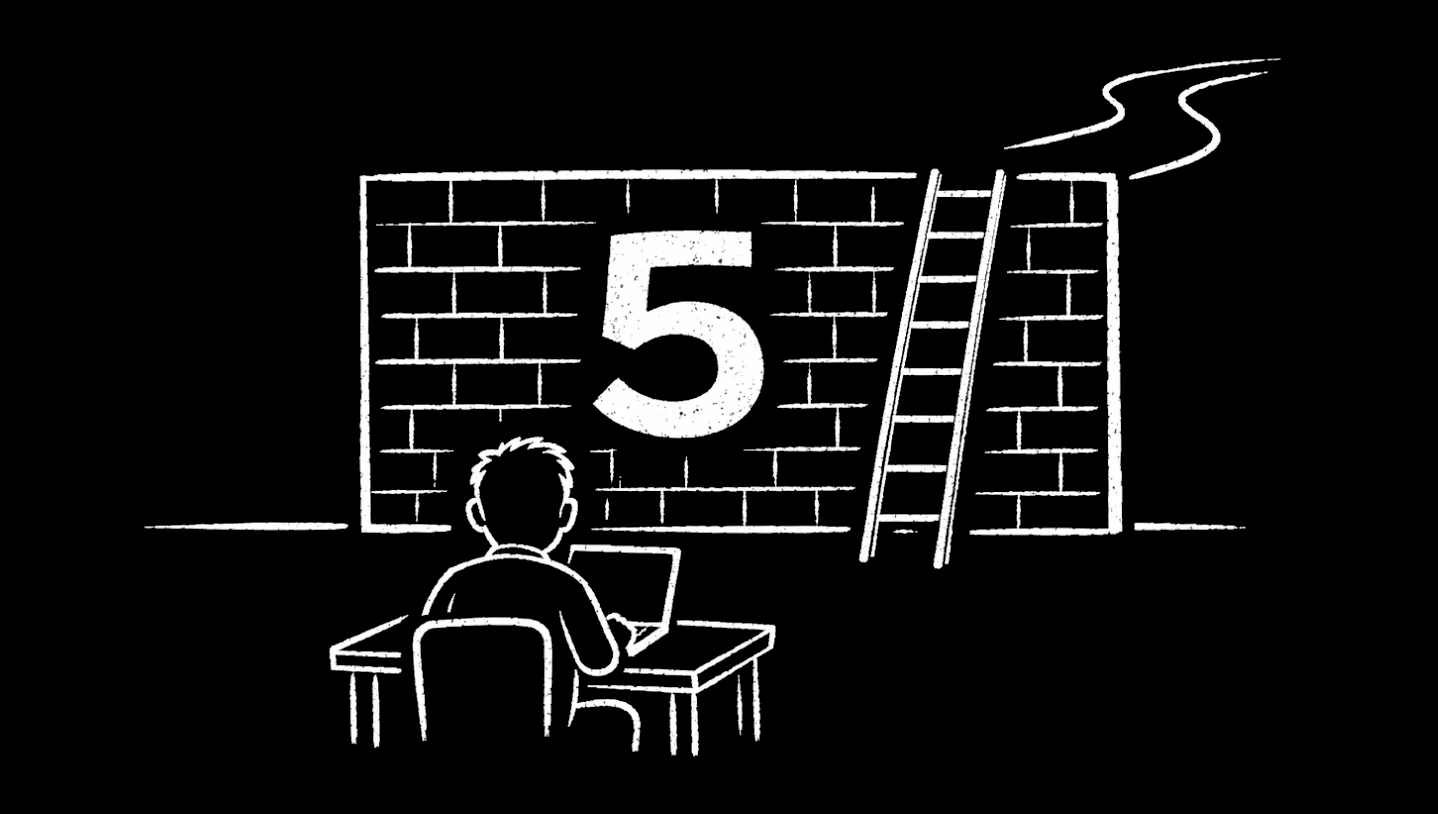
I spent five years at the same company. Came in as a designer. Moved to front end development. Then full stack. Then tech lead. Then architect.
Five years. Five roles. Constant motion.
And then I hit a wall.
Not a bad quarter. Not a difficult project. A wall. The kind where you look up and realize there's nowhere to go that doesn't require waiting. The director role might open eventually. A new team might form someday. But "eventually" and "someday" aren't growth. They're a waiting room.
The wall doesn't announce itself. It shows up disguised as comfort. You're good at the work. You're efficient. You know every corner of the codebase. Stakeholders trust you. Your team relies on you. Everything still "works."
That's exactly the problem. Everything working is what makes the wall invisible.
The Wall Makes You Face Yourself
Here's what nobody tells you about hitting the ceiling at a place you've outgrown. It's not an external problem. It's an internal one.
You have to look at yourself honestly and decide what you're willing to do about it. And there are really only two options. Find new opportunities within the company that get you over the wall, or find a way out and go somewhere else.
The worst option is the one I've seen too many engineers choose. They hit the wall and they just ... stay there. They stop growing. They keep delivering. They collect the paycheck and tell themselves this is fine. Maybe for some people it is. But for someone wired the way I'm wired, staying at the wall is where the slow death starts.
I compete against myself. That's one of my core strengths. Not against other people. Against yesterday's version of me. I need to feel like I'm getting better at something. Learning something. Pushing into something that's harder than what I did last month. When that stops, the flatness sets in. And once it sets in, it compounds fast.
For me, the answer was finding my way out. Not through the obvious door. Not by waiting in line for the role that might open in two years. By going somewhere nobody expected me to go. I took on a completely new team at a new company. Back in the deep end. Learning to swim again.
And the energy came back immediately. Because the wall was never about ability. It was about having nowhere left to climb.
Here's how I know I'm not at the wall right now. I'm fervently learning. The problems I'm working on during the day are genuinely challenging me. I'm reading more. Digging into things I don't understand yet. My curiosity is wandering into spaces I haven't mapped.
When that stops, when the work stops making you think and just becomes motion, that's the signal. That's the wall forming. And I've learned to pay attention to it early because by the time the silence feels normal, you've already been standing at the wall for months.
What the Wall Looks Like from the Other Side
As a leader, I've watched this happen to engineers I manage. And the hardest part is that the best ones don't come to you with it. They don't say "I've stalled." They don't say "I need a new challenge." They just quietly start operating at 70% of what they're capable of and nobody flags it because 70% of their best is still better than most people's 100%.
I had a front end developer on my team who'd been in the same stack for years. Good at it. Efficient. Reliable. But the technology was moving and he wasn't moving with it. He hadn't learned React. Not because he couldn't. Because nothing forced him to. The work kept coming in the stack he already knew and he kept delivering it.
I had to call it out. In a one-on-one I told him what I was seeing. Not that his work was bad. That his growth had stopped. And that the gap between where the industry was heading and where his skills were sitting was getting wider every quarter.
That conversation wasn't comfortable. But he heard it. He committed to learning React. Built real things with it. And it ended up being part of what got him his next job.
If I hadn't named it, he'd still be writing the same code in the same framework, getting slightly more efficient at something the industry was moving past. The wall would have become permanent. Not because he chose it. Because nobody told him he was standing in front of one.
Why Year Five
There's something specific about the five year mark. It's not arbitrary.
Years one and two, you're learning. Acquiring. Everything is new. The stack, the team, the domain, the way the company operates. Growth is automatic because ignorance is high and every day closes a gap.
Years three and four, you're executing. You start expressing everything you absorbed in the first two years. You're leading things. Making more influence. Mentoring people. For me, this was when I moved into the tech lead and architect roles. At Converse, this was the phase where I was innovating on the checkout rebuild and bringing a team along that had never worked in React, helping them think through a completely new paradigm. You're giving back. It feels like the peak.
Year five is when you realize the peak was actually a plateau. You've mastered the domain. You've solved every category of problem the role will give you. The work that used to challenge you is now routine. And routine, for engineers who are wired to solve problems, is poison.
The dangerous part is that year five doesn't feel urgent. You're not failing. You're not struggling. You're comfortable. And comfort is the most effective career killer in engineering because it doesn't trigger any alarm bells. Your manager sees a reliable performer. Leadership sees a stable contributor. Nobody sees someone whose growth flatlined a year ago.
How to Break Through It
I'm not going to give you a framework. I'm going to tell you what I've seen work.
Grab the Thing Nobody Wants
I had an engineer who'd been solid for years but was clearly approaching the wall. Instead of waiting for someone to hand him the next challenge, he volunteered to lead a project he'd never led before. Different scope, different stakeholders, different kind of pressure than anything he'd owned.
He didn't ask me to hand him a growth opportunity. He saw the project, told me he wanted it, and made the case. That's the difference between engineers who break through and engineers who stall. The ones who break through don't wait for permission. They don't wait for a promotion cycle. They don't wait for someone to notice they're ready for more. They go find the hardest thing in the room and claim it.
My job was to get out of his way. Give him the trust and the space to figure it out without me hovering. He stumbled early. Made calls I wouldn't have made. But he was learning again. And within a few months he was operating at a level nobody on the team had seen from him before.
Most engineers never make that move. Not because they can't. Because their manager is managing eight other people and the fact that they're delivering reliably makes them the last person anyone's worried about. You're not on the radar for growth because you're not on the radar for problems. So if you can't find the scary problem on your own, tell your manager directly. Not hints. Not "I'm open to new opportunities." Say the actual thing. "I need a new challenge or I'm going to lose momentum."
I'd rather have an engineer tell me directly that they need more than have them leave six months later because they never said anything. That conversation gives me something to work with. Silence gives me a resignation letter.
The Engineers Who Stall
The engineers who stall at year five aren't the ones who lack ability. They never were. They're the ones who kept waiting for someone else to hand them the next level.
They waited for the promotion. They waited for the role to open. They waited for their manager to notice. They waited for the company to invest in their growth.
And while they waited, the technology moved. The industry moved. The people around them who weren't waiting moved.
Nobody is coming to pull you over the wall. You either climb it yourself or you furnish the room at the base of it and call it home.